

- Form
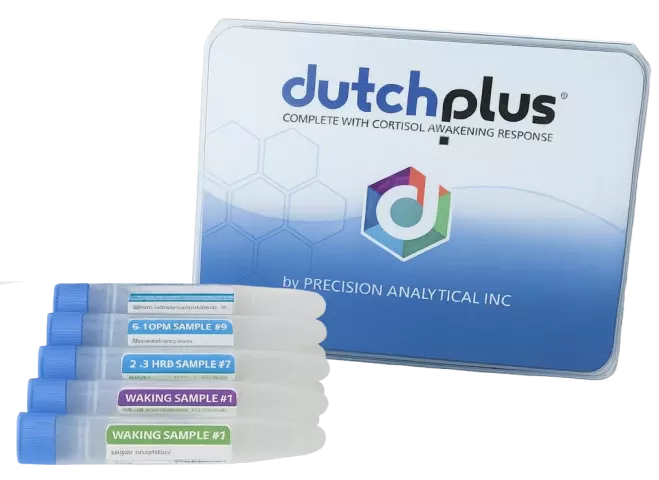
- At-home dried urine kit (several timed samples)
- Price
- $449 one-time, confirmed after eligibility review
- Prescription
- Yes, ordered by a licensed clinician
- FDA status
- Laboratory-developed test; not FDA-cleared or approved
How DUTCH Test (Dried Urine Hormone Panel) works
You urinate onto filter-paper strips at several set times across about a day, starting with the evening and including the moment you wake and the next morning. The strips dry, and you mail them to the lab. The lab measures sex hormones, their metabolites, and cortisol and cortisone at each time point, then reports patterns along with reference ranges.
Who it’s for, and who it isn’t
May be a fit
- Adults already in hormone care whose symptoms don't match their blood results
- People on hormone therapy where a clinician wants more context on how hormones are being processed
- People with sleep, energy or stress symptoms where a daily cortisol pattern could add information
- People who have already had a standard blood panel
Usually not a fit
- A first test: most people should start with a standard blood panel
- Diagnosing menopause, low testosterone or adrenal disease, which rely on blood tests and specific protocols
- Testing for 'adrenal fatigue', which is not a recognized medical diagnosis
- Cancer screening or deciding hormone doses on its own
- Anyone under 18
What’s included
- Clinician order and personalized collection instructions
- At-home kit with prepaid return to a CLIA-certified laboratory
- Clinician review of your report alongside your history and blood work
- Online visit to discuss results and next steps
- No membership fee
Possible side effects
- No physical side effects; collection is non-invasive
- Mistimed samples or missed collections can produce misleading results
- Borderline or unusual findings can cause worry or lead to unnecessary follow-up
This isn’t a complete list. Your clinician reviews risks, interactions and warnings with you before prescribing. In an emergency, call 911.
What the evidence says
Urinary hormone measurement is an established laboratory technique, and timed cortisol samples are used in medicine. However, interpreting estrogen metabolite ratios and many organic acid markers for routine care is debated, reference ranges are less established than for blood tests, and the test has not been reviewed by the FDA. The Menopause Society notes that optimal hormone levels for postmenopausal women have not been established.
What the DUTCH test measures
DUTCH stands for Dried Urine Test for Comprehensive Hormones. Instead of a single blood sample, you collect several urine samples on filter paper over roughly 24 hours. That allows the lab to look at patterns rather than one moment.
- Sex hormones: estrogens, progesterone metabolites, testosterone and DHEA
- Hormone metabolites: how estrogen and androgens are being broken down and cleared
- Cortisol and cortisone at several points in the day, including the rise after waking
- Some organic acid markers that relate to B vitamin status and neurotransmitter breakdown
When it can add something useful
A blood test tells you how much of a hormone is circulating at the moment of the draw. The DUTCH test adds information about how hormones are metabolized and how cortisol changes across a day. That can help in specific situations: symptoms that don't fit normal blood results, suspected disruption of the daily cortisol pattern, or questions about how a person on hormone therapy is processing it.
Your clinician decides whether those questions apply to you. If the answer would not change your care, the test is usually not worth the cost.
What it cannot tell you
It cannot diagnose menopause, low testosterone or adrenal disease. Conditions such as Cushing's syndrome or Addison disease are diagnosed with specific blood, urine or saliva protocols interpreted by a clinician. The Endocrine Society states that adrenal fatigue is not a recognized medical condition and that no test can detect it.
It also does not screen for cancer, replace mammograms or other screening, or set your hormone dose by itself. The Menopause Society advises that symptom response is the most reliable guide to hormone therapy doses, because hormone levels shift through the day and optimal levels have not been established.
DUTCH, saliva and blood compared
Blood tests are the standard for diagnosing hormone conditions and for safety monitoring, such as checking estradiol, testosterone, hematocrit or thyroid function. They are inexpensive, widely available and backed by established reference ranges.
Saliva hormone tests are often marketed alongside custom-compounded hormones. The Menopause Society says saliva testing is unnecessary and has not been proven accurate or reliable for this purpose. Dried urine sits between the two: it captures metabolites and several time points, but its role in everyday decisions is still being worked out. That is why your clinician treats it as a supplement to blood work, never a replacement.
How collection works
You receive a kit with labeled strips and a timing sheet. Typical collection points are late afternoon, bedtime, waking and two hours after waking, with a few extra waking samples for cortisol. Each strip dries before you package it for return.
Timing is everything. A sample taken an hour late or a missed waking sample can look like a real change in cortisol. Your instructions will also explain what to do about caffeine, alcohol, supplements and hormone doses on collection day; do not stop any prescribed treatment unless your clinician tells you to.
If you are on hormone therapy
The route you use matters. Vaginal estrogen, creams, patches and capsules are absorbed and processed differently, and urine metabolites may not mirror blood levels in a simple way. Your clinician will tell you when to collect relative to your dose.
Results are read as one piece of a larger picture that includes your symptoms, blood work and safety factors such as clot or breast cancer risk. A metabolite ratio alone is not a reason to start, stop or change therapy.
Regulatory status and price
The DUTCH test is a laboratory-developed test, designed and run within a single CLIA-certified lab. It has not been cleared or approved by the FDA. In September 2025 the FDA reverted its regulation after a court vacated the agency's 2024 rule that would have expanded oversight of these tests.
The price is $449, one-time, confirmed during your eligibility review. It is usually not covered by insurance. There is no membership fee.
Go deeper on DUTCH Test (Dried Urine Hormone Panel)
 Lab testingDUTCH Test results · 4 min readReading the cortisol curve on your DUTCH TestWhat the DUTCH daily cortisol curve shows, how to read a flat or high pattern, why 'adrenal fatigue' isn't a diagnosis, and when cortisol needs other tests.Read more
 HormonesDUTCH Test results · 4 min readEstrogen metabolites on your DUTCH report: useful context, not a crystal ballWhat the 2-OH, 4-OH and 16-OH estrogen pathways on a DUTCH report mean, what the evidence does and doesn't support, and why they don't predict cancer.Read more
 HormonesDUTCH Test and HRT · 4 min readUsing the DUTCH Test while you are on hormone therapyCan a DUTCH Test monitor HRT or TRT? How the route of your hormones changes urine results, when testing helps, and why symptoms still guide your dose.Read more
Prescription treatments are available only to eligible patients after a clinical evaluation by an independently licensed clinician.
DUTCH Test (Dried Urine Hormone Panel): common questions
Is the DUTCH test better than a blood test?
It measures different things. Blood tests remain the standard for diagnosing hormone conditions; DUTCH can add metabolite and daily rhythm detail for specific questions.
Can it diagnose adrenal fatigue?
No. The Endocrine Society says adrenal fatigue is not a recognized medical diagnosis, and no test can detect it.
Should I stop hormone therapy before testing?
Usually not. Your clinician will give instructions on timing relative to your dose. Do not stop a prescribed medicine on your own.
How accurate is it?
The lab methods are well established, but results depend heavily on accurate timing, and the clinical meaning of many metabolite ratios is still debated.
Is it covered by insurance?
Usually not. HealifyMD does not bill insurance; you may be able to use HSA or FSA funds depending on your plan.
What happens after my results?
You meet with your clinician to go through the report alongside your symptoms and blood work, and decide whether anything should change.
Do I need blood work first?
In most cases yes. A standard panel is the foundation, and the DUTCH test is added only when it can answer a specific question.
Sources
We cite government agencies, professional societies and peer-reviewed research. See our editorial policy.
- What is hormone testing?The Menopause Society
- Adrenal fatigueEndocrine Society
- Cortisol testMedlinePlus (National Library of Medicine)
- Laboratory developed testsU.S. Food and Drug Administration