

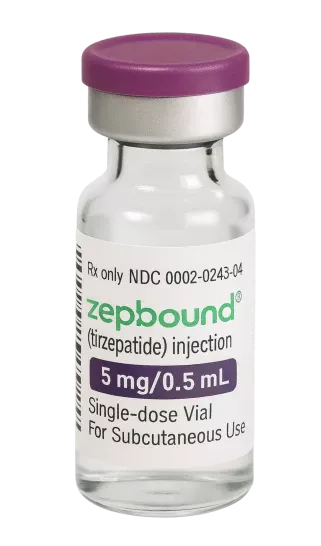
- Program fee
- $75/month, or $150 for 3 months ($50/month)
- Medication (LillyDirect self-pay)
- 2.5 mg $299/month, 5 mg $399/month, 7.5 to 15 mg $449/month
- Form
- Once-weekly injection
- FDA status
- FDA-approved brand-name medicine

How Zepbound® works
You book and meet a licensed clinician live. If Zepbound is right for you, your prescription is sent directly to LillyDirect, Eli Lilly's pharmacy service, which bills you for the medicine and ships it to your home. The HealifyMD program fee covers your clinical care.
Who it’s for, and who it isn’t
May be a fit
- Adults with a BMI of 30 or more, or 27 or more with a weight-related condition
- Adults with obesity and moderate to severe obstructive sleep apnea
- People who want the FDA-approved brand of tirzepatide rather than a compounded version
- People comfortable with a weekly injection
Usually not a fit
- Anyone with a personal or family history of medullary thyroid carcinoma or multiple endocrine neoplasia type 2 (MEN 2)
- Pregnancy, breastfeeding or plans to conceive soon
- A history of pancreatitis or severe gastrointestinal disease such as gastroparesis, unless your clinician advises otherwise
- Anyone already taking another GLP-1 or tirzepatide product
- Anyone under 18
What’s included
- Live visit with a licensed clinician
- A Zepbound prescription sent to LillyDirect, only if it is medically appropriate
- Dose-step plan that follows the FDA label
- Follow-up for side effects and dose questions
- Subscription you can cancel anytime
Possible side effects
- Common: nausea, diarrhea, vomiting, constipation, stomach pain, indigestion and reduced appetite, mostly while doses are rising
- Less common but serious: pancreatitis, gallbladder problems, kidney injury from dehydration and low blood sugar when combined with insulin or a sulfonylurea
- Seek urgent care for severe stomach pain that does not go away, signs of an allergic reaction or trouble swallowing
- Boxed warning: tirzepatide caused thyroid C-cell tumors in rats; whether it does in people is unknown
- Tirzepatide can make birth control pills less reliable for a few weeks after starting and after each dose increase
This isn’t a complete list. Your clinician reviews risks, interactions and warnings with you before prescribing. In an emergency, call 911.
What the evidence says
In the 72-week SURMOUNT-1 trial, adults with obesity lost an average of 15%, 19.5% and 20.9% of body weight on the 5 mg, 10 mg and 15 mg doses, compared with 3.1% on placebo. In 2024 the FDA also approved Zepbound for moderate to severe obstructive sleep apnea in adults with obesity.
What you pay, and to whom
The HealifyMD program is $75 a month, or $150 for 3 months ($50 a month). That covers your live clinician visit, the prescription if you qualify and ongoing follow-up.
Zepbound is paid for separately to LillyDirect. If you are prescribed it, your prescription goes straight to LillyDirect for billing and home delivery. Current LillyDirect self-pay prices:
- 2.5 mg: $299/month
- 5 mg: $399/month
- 7.5 mg, 10 mg, 12.5 mg and 15 mg: $449/month
How the doses step up
Zepbound is injected once a week. Everyone starts at 2.5 mg for 4 weeks, which is a starter dose rather than a treatment dose. The dose then rises by 2.5 mg at least every 4 weeks as needed, up to a maximum of 15 mg.
Your clinician sets the pace. Many people do well at 5 mg or 10 mg and never need the top dose, and staying on a dose a little longer is a normal way to handle nausea.
Why tirzepatide works differently
Semaglutide acts on one gut hormone receptor, GLP-1. Tirzepatide acts on two, GIP and GLP-1, which together reduce appetite and help the body handle sugar. In trials, average weight loss on the highest Zepbound doses was larger than on semaglutide 2.4 mg, although individual results vary.
Zepbound or compounded tirzepatide
Zepbound is made by Eli Lilly and is FDA-approved. Compounded tirzepatide is prepared by a licensed pharmacy for an individual patient and has not been reviewed by the FDA for safety, effectiveness or quality.
Through HealifyMD, compounded tirzepatide is $399 for 1 month or $750 for 2 months with the medicine included. If you prefer the brand, this program is the way to get it.
Safety points to know first
Zepbound has a boxed warning about thyroid C-cell tumors in rats and is not used by anyone with a personal or family history of medullary thyroid carcinoma or MEN 2. Stomach side effects are the most common problem, especially after a dose increase.
If you take birth control pills, use a backup method or switch to a non-oral method for 4 weeks after starting and after each dose increase, as the label advises. Never combine Zepbound with another GLP-1 or tirzepatide product.
Prescription treatments are available only to eligible patients after a clinical evaluation by an independently licensed clinician.
Zepbound®: common questions
How much does Zepbound cost through HealifyMD?
The program is $75 a month or $150 for 3 months. LillyDirect bills the medicine separately: $299 a month for 2.5 mg, $399 for 5 mg and $449 for 7.5 mg, 10 mg, 12.5 mg or 15 mg.
Is the medicine included in the program fee?
No. The program covers your clinical care. If prescribed, Zepbound is billed and shipped by LillyDirect.
Can LillyDirect prices change?
Yes. Zepbound prices are set by Eli Lilly and may change at any time. Additional terms and eligibility requirements may apply.
Do I need insurance?
No. These are self-pay prices. If you have insurance that covers Zepbound, your clinician can still prescribe it and you can use your coverage instead.
Will I definitely be prescribed Zepbound?
No. It is prescribed only when medically appropriate, and not everyone qualifies.
Can I cancel?
Yes. The program is a subscription you can cancel anytime.
Sources
We cite government agencies, professional societies and peer-reviewed research. See our editorial policy.
- Zepbound (tirzepatide) prescribing informationU.S. Food and Drug Administration
- Tirzepatide once weekly for the treatment of obesity (SURMOUNT-1)New England Journal of Medicine
- Prescription medications to treat overweight and obesityNational Institute of Diabetes and Digestive and Kidney Diseases