

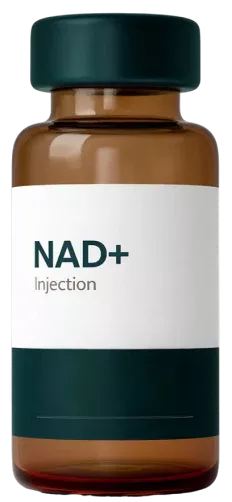
- Form
- Subcutaneous injection, self-administered at home
- Price
- From $199/month; 3 months $499 ($166/month)
- Prescription
- Required, after clinician review
- FDA status
- Compounded; not FDA-approved
NAD+ Injection is a compounded medication. Compounded medications are not FDA-approved, and the FDA has not reviewed them for safety, effectiveness or quality. What compounded means
How NAD+ Injection works
NAD+ (nicotinamide adenine dinucleotide) shuttles electrons in the mitochondria during energy production and is used by enzymes involved in DNA repair and cell signaling, such as sirtuins and PARPs. Injecting NAD+ bypasses the gut. In the body it is broken down quickly into related compounds, so how much intact NAD+ reaches cells is not fully understood.
Who it’s for, and who it isn’t
May be a fit
- Adults interested in cellular-energy and healthy-aging approaches who accept that evidence is early
- People who have already checked common causes of fatigue such as thyroid, iron, vitamin D, sleep and blood sugar
- People comfortable giving themselves small injections under the skin
Usually not a fit
- People who are pregnant or breastfeeding
- Anyone with active cancer, unless their oncology team agrees
- People with significant kidney or liver disease without specialist review
- Anyone expecting NAD+ to treat a diagnosed medical condition
- People with unexplained fatigue that has not yet been evaluated
What’s included
- Clinician review of goals, health history and medications
- Guidance on screening for other causes of low energy (labs priced separately)
- Medication and supplies from a licensed U.S. pharmacy
- Injection training
- Follow-up to judge tolerance and whether to continue
Possible side effects
- Redness, stinging or tenderness at the injection site
- Flushing or warmth
- Nausea
- Headache or lightheadedness
- Stomach cramping or chest tightness, which some people report with larger or faster doses
This isn’t a complete list. Your clinician reviews risks, interactions and warnings with you before prescribing. In an emergency, call 911.
What the evidence says
The biology of NAD+ is well established, and lab and animal studies are promising. In humans, a 2023 review in The Journals of Gerontology found that oral NAD+ boosters are safe and raise NAD+ levels, but clinical evidence that this improves physiological function is unclear. Studies of injected or infused NAD+ are fewer and smaller still; a pilot study of a 6-hour IV infusion in eight men tracked how NAD+ was broken down rather than any health outcome.
What NAD+ actually does
NAD+ is a coenzyme found in every living cell. It is central to how mitochondria convert nutrients into usable energy, and it is consumed by enzymes that repair DNA and regulate how cells respond to stress. Research in animals shows NAD+ levels fall with age, and restoring them can improve some markers of aging in those models.
Your body makes NAD+ from vitamin B3 forms and from the amino acid tryptophan. That is why supplements such as nicotinamide riboside (NR) and nicotinamide mononucleotide (NMN) exist: they aim to raise NAD+ indirectly. An injection delivers NAD+ itself.
Where the human evidence stands
Here is the honest summary. Raising NAD+ in people is achievable, and short-term use appears well tolerated. What has not been shown is that it reliably boosts energy, thinking, exercise capacity or lifespan in healthy adults. Human trials are mostly small, short and focused on whether levels rise rather than on how people feel or function.
That does not mean it cannot help anyone, only that any benefit is uncertain and individual. If you try NAD+, go in with a defined trial period and realistic expectations, and be wary of claims that promise reversed aging.
Injection, IV or oral precursors
IV infusions deliver large amounts over hours and commonly cause flushing, nausea or chest tightness when run quickly. Subcutaneous injections use smaller amounts you can give at home in minutes. Oral NR and NMN are the most studied in clinical trials and are sold as supplements without a prescription. No head-to-head trials show that one route produces better outcomes than another.
FDA status
NAD+ injections are compounded by a licensed U.S. pharmacy. They are not FDA-approved for any use, FDA has not reviewed them for safety, effectiveness or quality, and they are not equivalent to any branded product. NAD is listed by FDA as a bulk substance nominated for compounding under section 503A and placed in Category 1, meaning it is still under evaluation and pharmacies may use it under FDA's interim policy while a final decision is pending.
A poor first move for fatigue
Midlife tiredness has many causes, and most are treatable: low iron or B12, thyroid problems, poor sleep or sleep apnea, perimenopause or low testosterone, depression, medication side effects and blood sugar problems. NAD+ addresses none of these directly. Your clinician may suggest checking the basics first so that you do not spend months on a treatment that misses the real problem.
- Sleep quality and possible sleep apnea
- Thyroid function, iron stores and B12
- Blood sugar and insulin resistance
- Hormone status in perimenopause or andropause
- Mood and stress
Who should skip it
NAD+ is not appropriate during pregnancy or breastfeeding, because there is no safety data. People with active cancer should talk with their oncology team first, since NAD+ supports the metabolism of all cells, including tumor cells, and the implications are not well understood. Significant kidney or liver disease, a long medication list or a history of strong reactions to injections also call for a careful review before starting.
It is also worth skipping if your main goal is to treat a specific diagnosis, such as long COVID, depression or addiction recovery. Those uses are promoted online, but they have not been established in controlled trials, and they deserve care aimed directly at the condition. Your clinician can help you find that care.
What your clinician monitors
After training on how to inject, you will check in about how you tolerate the doses and whether you notice any change in energy, focus or recovery. If side effects such as nausea or flushing occur, the dose or timing can be adjusted. If there is no meaningful change after a fair trial, stopping is a sensible choice.
NAD+ injections cost from $199 a month, or $349 for 2 months ($175 a month) or $499 for 3 months ($166 a month), with no membership fee. Labs are billed separately, and your price is confirmed at the eligibility review.
Go deeper on NAD+ Injection
 Longevity & NAD+NAD+ injection · 4 min readNAD+ and alcohol: separating the biochemistry from the hangover hypeAlcohol metabolism does use up NAD+, but no trial shows NAD+ injections cure hangovers or detox the liver. Here's the real biochemistry and what actually helps.Read more
 Longevity & NAD+NAD+ injection · 4 min readNAD+ and cognition: a reasonable idea still waiting for proofNAD+ declines with age and fuels brain energy, but human trials haven't shown clear cognitive gains. See what is known and what to check first for brain fog.Read more
 Longevity & NAD+NAD+ injection · 4 min readNAD+ for long COVID and post-viral fatigue: encouraging idea, unproven treatmentViral infection can drain NAD+ in cells, so NAD+ has been proposed for long COVID fatigue. See what small studies found, what is unproven and what to check.Read more
 Longevity & NAD+NAD+ injection · 4 min readNAD+ injection side effects: what is common, what is not, and when to callCommon NAD+ injection side effects include site redness, flushing, nausea and tiredness. See why IV drips feel different, when to stop and who should take care.Read more
Prescription treatments are available only to eligible patients after a clinical evaluation by an independently licensed clinician.
NAD+ Injection: common questions
Is NAD+ FDA-approved?
No. Compounded NAD+ injections are not FDA-approved for any use, and FDA has not reviewed their safety or effectiveness.
Is an injection better than an IV?
There is no head-to-head evidence. Injections use smaller amounts at home; IV infusions deliver more but take hours and often cause flushing or nausea.
How does it compare with NMN or NR supplements?
Those supplements raise NAD+ indirectly and have more human trial data. None of the routes has proven health benefits in healthy adults.
How soon would I notice anything?
Some people report changes within a few weeks, while many notice nothing. A defined trial of several weeks helps you decide.
Can NAD+ be combined with other treatments?
Often, but your clinician will review your full medication and supplement list first, especially if you have kidney or liver disease or cancer history.
Does the injection hurt?
It uses a small needle under the skin. Stinging or redness at the site is common and usually brief.
Should I fix my sleep first?
Yes, if sleep is a problem. Better sleep has far stronger evidence for energy than NAD+ does.
Sources
We cite government agencies, professional societies and peer-reviewed research. See our editorial policy.
- Dietary Supplementation With NAD+-Boosting Compounds in Humans: Current Knowledge and Future DirectionsThe Journals of Gerontology: Series A (via University of Delaware)
- A pilot study of changes in the human plasma and urine NAD+ metabolome during a 6-hour IV NAD+ infusionFrontiers in Aging Neuroscience
- Bulk Drug Substances Used in Compounding Under Section 503A of the FD&C ActU.S. Food and Drug Administration
- Bulk Drug Substances Nominated for Use in Compounding Under Section 503AU.S. Food and Drug Administration
- Compounding and the FDA: Questions and AnswersU.S. Food and Drug Administration