

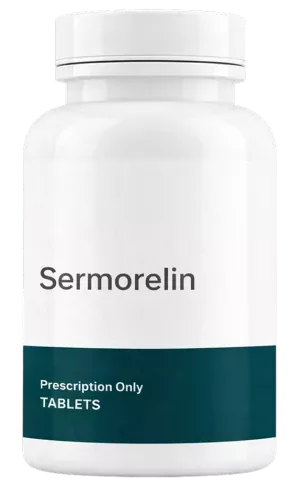
- Form
- Orally dissolving tablet or injection, with or without glycine
- Price
- From $199/month (2 months $349, $175/month)
- Prescription
- Required, after clinician review
- FDA status
- Compounded; not FDA-approved (former injectable brand discontinued)
Sermorelin ODT is a compounded medication. Compounded medications are not FDA-approved, and the FDA has not reviewed them for safety, effectiveness or quality. What compounded means
How Sermorelin ODT works
Sermorelin is a 29-amino-acid fragment of growth hormone-releasing hormone (GHRH). It binds GHRH receptors in the pituitary and prompts it to release your own growth hormone in pulses. The body's normal feedback controls, such as somatostatin and IGF-1, still apply, which is different from injecting growth hormone directly.
Who it’s for, and who it isn’t
May be a fit
- Adults in midlife interested in the growth hormone axis who understand the evidence is limited
- People who have already addressed sleep, training, nutrition and other hormone issues
- Those who prefer a needle-free option and accept that oral absorption is uncertain
Usually not a fit
- Anyone with active cancer or a history of cancer without specialist input
- People who are pregnant or breastfeeding
- People with untreated hypothyroidism or pituitary disease
- People with poorly controlled diabetes
- Anyone under 18
- People seeking a proven anti-aging or muscle-building treatment
What’s included
- Clinician review of goals, history and other medicines
- Optional baseline IGF-1 and glucose labs (priced separately)
- Medication shipped from a licensed U.S. pharmacy
- Follow-up to decide whether to continue
Possible side effects
- Flushing
- Headache
- Nausea or mouth irritation
- Dizziness
- Possible rises in blood sugar
- Fluid retention or joint aches if growth hormone activity rises substantially
This isn’t a complete list. Your clinician reviews risks, interactions and warnings with you before prescribing. In an emergency, call 911.
What the evidence says
Injectable sermorelin was FDA-approved (as Geref) to diagnose and treat growth hormone deficiency in children, and studies show it raises growth hormone and IGF-1. Evidence for benefits in healthy middle-aged adults, such as better sleep, body composition or energy, comes from small, short studies. There are no published controlled trials of a sermorelin dissolving tablet, and how much is absorbed through the mouth is not established.
What sermorelin is
Your hypothalamus releases growth hormone-releasing hormone, GHRH, which tells the pituitary gland to release growth hormone. Growth hormone then drives the liver to make IGF-1, which carries out many of its effects on muscle, bone, fat and repair. Both growth hormone and IGF-1 tend to decline with age.
Sermorelin mimics the active part of GHRH. Instead of supplying growth hormone, it encourages your pituitary to make more of its own, within the limits of normal feedback. That is the main reason it is often described as gentler than growth hormone injections, though gentler does not mean proven.
Its regulatory history
Injectable sermorelin was sold in the U.S. under the brand name Geref, approved for children with growth hormone deficiency and for testing pituitary function. The manufacturer discontinued it in 2008, and in 2013 FDA determined that it was not withdrawn for reasons of safety or effectiveness.
Today sermorelin is available only from compounding pharmacies. The ODT prescribed here is compounded by a licensed U.S. pharmacy; it is not FDA-approved, has not been reviewed by FDA for safety, effectiveness or quality and is not equivalent to the former branded injection. Sermorelin does not appear on FDA's list of bulk substances flagged for significant safety concerns, but that is not the same as an approval.
The honest picture on evidence
It is well documented that sermorelin can raise growth hormone and IGF-1 when injected. What is not well documented is whether that translates into meaningful benefits for healthy adults in their 40s, 50s or 60s. The available studies are small, short and often used injections.
The dissolving tablet adds another unknown. Peptides are usually broken down in the mouth and gut, and absorption through the mouth lining is generally low. No controlled trials have measured how much sermorelin an ODT delivers. Your clinician may check IGF-1 to see whether anything is changing, but a normal IGF-1 response is not proof of benefit.
How the tablet is used
Your prescription label gives the exact instructions, and your clinician sets the dose; this page does not provide home dosing. In general, a dissolving tablet is placed in the mouth and left to dissolve rather than swallowed, often in the evening because the body's largest growth hormone pulses happen during early deep sleep.
Because absorption through the mouth is uncertain, consistency matters. Taking it the same way and at the same time each day, away from food and drink as instructed, gives you and your clinician the best chance of telling whether it is doing anything. Keep a simple log of sleep, energy and recovery for the first few weeks; it is more useful at follow-up than memory.
Who should not take it
Because growth hormone and IGF-1 promote cell growth, anyone with active cancer, or a past cancer without specialist input, should avoid sermorelin. It is not for use during pregnancy or breastfeeding. Untreated thyroid or pituitary problems should be addressed first, since they affect the same hormone systems. Growth hormone activity can raise blood sugar, so people with diabetes need careful review.
Fix the foundations first
Growth hormone is released mainly during deep sleep and after intense exercise. Short or broken sleep, untreated sleep apnea, heavy evening drinking and a sedentary routine all blunt it. Addressing those is free, low-risk and often more effective than any peptide. Your clinician may suggest labs for thyroid, testosterone or estrogen status, iron and blood sugar before considering sermorelin.
What your clinician monitors
If you start, your clinician sets a trial period with clear goals. Follow-up asks about sleep, recovery, energy and any side effects such as headache, flushing or swelling. Labs may include IGF-1 and fasting glucose to make sure levels stay in a sensible range. If nothing has changed after a fair trial, stopping is a reasonable outcome.
Sermorelin ODT is from $199 a month, or $349 for two months ($175 a month), with no membership fee. Labs are billed separately and your price is confirmed at the eligibility review.
Go deeper on Sermorelin ODT
 PeptidesSermorelin ODT · 4 min readSermorelin and cancer risk: an honest lookWhat is known and unknown about sermorelin and cancer: the IGF-1 link from population studies, the lack of long-term trials and the safeguards clinicians use.Read more
 PeptidesSermorelin ODT · 4 min readIGF-1: the number used to monitor sermorelinWhy IGF-1 is the blood test used to track sermorelin, how age changes the normal range, what a rise does and does not tell you, and when it is usually checked.Read more
 PeptidesSermorelin ODT · 4 min readCan sermorelin improve your sleep?How growth hormone and deep sleep are linked, what older GHRH studies found, why sermorelin is not an insomnia or sleep apnea treatment and what to check first.Read more
Prescription treatments are available only to eligible patients after a clinical evaluation by an independently licensed clinician.
Sermorelin ODT: common questions
How is sermorelin different from growth hormone?
Growth hormone injections supply the hormone directly. Sermorelin signals your pituitary to release its own, within normal feedback limits.
Is sermorelin FDA-approved?
Not currently. The injectable brand was approved for children with growth hormone deficiency but discontinued in 2008. Compounded sermorelin is not FDA-approved.
Does the dissolving tablet work as well as injections?
That has not been studied. Oral absorption of peptides is generally low, so effects may be weaker or less predictable.
Will it help me build muscle or lose fat?
There is no good evidence that it does so meaningfully in healthy adults. Strength training and nutrition have far stronger evidence.
Can it improve sleep?
Some people report better sleep, but controlled evidence is limited. Treating sleep apnea and improving sleep habits have more reliable effects.
Does sermorelin increase cancer risk?
There is no direct evidence that it causes cancer, but raising growth hormone and IGF-1 could theoretically fuel existing tumors, so it is avoided with active or recent cancer.
When might I notice anything?
If effects occur, people usually describe them over weeks to a few months. Your clinician will set a defined trial period.
Is sermorelin available as an injection?
Yes. Sermorelin is available as a dissolving tablet or an injection, either pure or combined with glycine. Your clinician will recommend the form that suits you; pricing starts at $199/month.
Sources
We cite government agencies, professional societies and peer-reviewed research. See our editorial policy.
- Determination That GEREF (Sermorelin Acetate) Was Not Withdrawn From Sale for Reasons of Safety or EffectivenessFederal Register (U.S. Food and Drug Administration)
- Certain Bulk Drug Substances for Use in Compounding that May Present Significant Safety RisksU.S. Food and Drug Administration
- IGF-1 (Insulin-like Growth Factor 1) TestMedlinePlus (National Library of Medicine)
- Bulk Drug Substances Used in Compounding Under Section 503A of the FD&C ActU.S. Food and Drug Administration
- Compounding and the FDA: Questions and AnswersU.S. Food and Drug Administration