

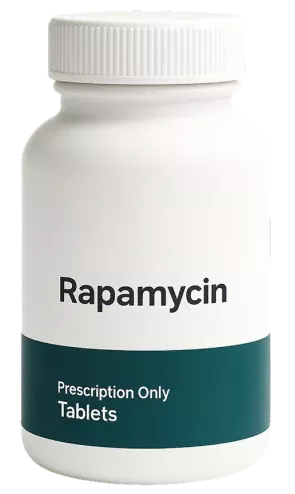
- Form
- Oral tablet, typically taken intermittently
- Price
- From $99/month (3 months $249, $83/month)
- Prescription
- Required, after clinician review and labs
- FDA status
- FDA-approved for transplant and LAM; longevity use is off-label
How Rapamycin (Sirolimus) works
Rapamycin inhibits mTOR, a protein complex that acts as a growth switch for cells. When nutrients are plentiful, mTOR drives growth and protein production; when it is dialed down, cells shift toward maintenance and recycling processes such as autophagy. Chronic high-dose rapamycin also suppresses immune responses, which is why it is used in transplant medicine. Low intermittent dosing aims to capture the maintenance effect with less immune suppression.
Who it’s for, and who it isn’t
May be a fit
- Healthy adults in midlife or later who are interested in longevity research and accept uncertain benefit
- People willing to have baseline and follow-up blood work
- People without frequent infections, slow-healing wounds or immune problems
Usually not a fit
- Anyone with an active infection, recurring serious infections or a weakened immune system
- People with active cancer or a history of skin cancer or lymphoma without specialist input
- People who are pregnant, trying to conceive or breastfeeding
- People with poorly controlled diabetes or very high cholesterol or triglycerides
- Anyone with surgery or a significant wound expected soon
- People taking strong CYP3A4 inhibitors or inducers that interact with sirolimus
What’s included
- Clinician review of history, medications and goals
- Baseline lab planning: blood count, lipids, glucose, kidney and liver function (labs priced separately)
- Prescription filled by a licensed U.S. pharmacy
- Follow-up and repeat labs to check tolerance
Possible side effects
- Mouth sores (aphthous ulcers)
- Higher cholesterol and triglycerides
- Higher blood sugar
- More frequent or longer-lasting infections
- Slower wound healing
- Skin rash, acne or swelling of the legs
This isn’t a complete list. Your clinician reviews risks, interactions and warnings with you before prescribing. In an emergency, call 911.
What the evidence says
In a landmark 2009 study funded through the NIH Interventions Testing Program, rapamycin started late in life extended median and maximum lifespan in genetically diverse mice. Human data are far more limited. The 48-week PEARL trial of weekly compounded rapamycin (5 or 10 mg) in healthy adults found no change in its primary outcome, visceral fat, though some secondary measures improved and adverse events were similar to placebo. No trial has shown that rapamycin extends human lifespan.
Why rapamycin draws so much attention
Most supplements marketed for longevity have little more than cell-culture data behind them. Rapamycin is different: in carefully designed mouse studies run at three separate sites, it lengthened lifespan in both males and females, even when started in late middle age. Similar effects have been seen in yeast, worms and flies.
That consistency is why some clinicians and researchers are interested in testing it in people. But mice are not people, and the doses, schedules and outcomes that matter for humans are still being worked out.
What the human research does and does not show
The best human data so far come from small, relatively short trials. PEARL followed healthy adults for 48 weeks on weekly doses and found the drug was reasonably well tolerated, with adverse events similar to placebo. Its main question, whether visceral fat would fall, came back negative. Some secondary results, such as lean mass and pain in women on the higher dose and self-reported well-being on the lower dose, looked favorable, but secondary findings need confirmation.
Other studies of rapamycin and related drugs in older adults have looked at immune responses to vaccines and other specific measures, with mixed results. What is missing is any long-term evidence on the outcomes people care about most: living longer, avoiding disease and staying independent. Anyone who takes rapamycin for longevity today is, in effect, acting ahead of the evidence.
FDA status
Sirolimus, the generic name for rapamycin, is FDA-approved to prevent kidney transplant rejection and to treat lymphangioleiomyomatosis (LAM), a rare lung disease. Using it for healthy aging is off-label. Your prescription is a standard FDA-approved sirolimus product dispensed by a licensed pharmacy; it is not compounded. Note that some research, including the PEARL trial, used compounded rapamycin, which may not behave identically.
The boxed warning
Sirolimus carries a boxed warning because it suppresses the immune system. At transplant doses it increases the risk of serious infections and certain cancers, particularly lymphoma and skin cancer, and it has caused serious harm in liver and lung transplant patients. Longevity regimens use much lower and less frequent doses, and short-term human studies have not shown the same problems, but the warning describes real effects of the drug that your clinician takes seriously.
Side effects to know about
Mouth sores are the most commonly reported side effect at low doses. Rapamycin can also raise cholesterol, triglycerides and blood sugar, slow wound healing and make infections last longer. Because it interacts with grapefruit and with many drugs that affect the CYP3A4 liver enzyme, including some antibiotics, antifungals and seizure medicines, every new prescription should be checked.
Sun exposure deserves attention too, since the drug is linked with skin cancer at higher doses. Use sun protection and keep up with skin checks.
- Pause and contact your clinician if you develop a fever or significant infection
- Plan around surgery or dental procedures, since healing may be slower
- Avoid grapefruit and grapefruit juice
- Ask before any vaccination, especially live vaccines
Who should not take it
Rapamycin is not for anyone with a weakened immune system, frequent infections, active cancer or a history of skin cancer or lymphoma without specialist input. It should not be used in pregnancy, while trying to conceive or while breastfeeding. Uncontrolled diabetes or very high lipids also argue against it, as do upcoming surgeries.
What your clinician monitors
Before starting, your clinician orders or reviews a complete blood count, lipid panel, fasting glucose or A1c and kidney and liver tests. These are repeated after a few months and periodically afterward, along with questions about mouth sores, infections and wound healing. If lipids or glucose rise meaningfully, the dose or schedule may change, or rapamycin may be stopped.
It also helps to decide in advance what would count as success, since there is no validated blood test for slowed aging. Rapamycin is from $99 a month, or $249 for three months ($83 a month), with no membership fee. Labs are billed separately, and your price is confirmed at the eligibility review.
Go deeper on Rapamycin (Sirolimus)
 Getting startedRapamycin · 5 min readRapamycin, infections and vaccines: what changes at longevity dosesDoes low-dose rapamycin weaken immunity? How transplant and longevity dosing differ, what PEARL found, and practical rules for vaccines, illness and surgery.Read more
 Getting startedRapamycin · 4 min readRapamycin and mouth ulcers: why they happen and what helpsMouth sores are among the most common rapamycin side effects. Learn why mTOR inhibitors cause them, what eases them, and when ulcers mean a change of plan.Read more
 Getting startedRapamycin · 4 min readSirolimus, Rapamune and rapamycin: one molecule, several namesRapamycin, sirolimus and Rapamune are the same molecule under different names. Learn how generic, brand and compounded versions differ and what HealifyMD uses.Read more
 Getting startedRapamycin · 4 min readRapamycin for women: ovarian aging, menopause and what to know firstCan rapamycin slow ovarian aging or delay menopause? What mouse studies and early human research show, the pregnancy rules and how it compares with HRT.Read more
Prescription treatments are available only to eligible patients after a clinical evaluation by an independently licensed clinician.
Rapamycin (Sirolimus): common questions
Is rapamycin FDA-approved for longevity?
No. Sirolimus is FDA-approved for kidney transplant rejection and LAM. Longevity use is off-label and unproven in humans.
Is rapamycin the same as sirolimus?
Yes. Rapamycin is the original name of the compound; sirolimus is its generic drug name.
Why is it taken weekly rather than daily?
Intermittent dosing is intended to reduce immune suppression and side effects while still affecting mTOR. Your clinician sets the schedule.
Will rapamycin make me catch infections?
It can make infections more likely or longer-lasting, especially at higher doses. Report fevers or infections promptly.
What are the mouth sores like?
They resemble canker sores and usually heal on their own. Tell your clinician if they are frequent or painful.
Can women take rapamycin?
Yes, if they are not pregnant, trying to conceive or breastfeeding. In the PEARL trial, some secondary improvements were seen only in women on the higher dose, but the results are preliminary.
How will I know if it is working?
There is no reliable test for slowed aging. Your clinician will track safety labs and how you feel, and help you judge whether continuing makes sense.
Sources
We cite government agencies, professional societies and peer-reviewed research. See our editorial policy.
- SirolimusMedlinePlus (National Library of Medicine)
- Rapamycin fed late in life extends lifespan in genetically heterogeneous miceNature
- Influence of rapamycin on safety and healthspan metrics after one year: PEARL trial resultsAging (Albany NY)