

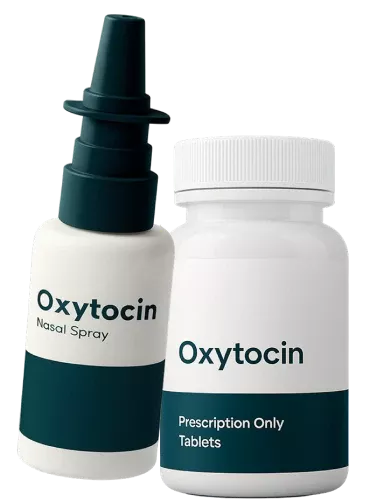
- Form
- Compounded preparation, used as directed
- Price
- From $149/month; 3 months $349 ($116/month)
- Prescription
- Required, after clinician review
- FDA status
- Compounded; not FDA-approved for sexual wellness
Oxytocin is a compounded medication. Compounded medications are not FDA-approved, and the FDA has not reviewed them for safety, effectiveness or quality. What compounded means
How Oxytocin works
Oxytocin is made in the hypothalamus and released by the pituitary. In the body it triggers uterine contractions and milk let-down; in the brain it is involved in bonding, trust and social reward, and it rises during touch, sex and orgasm. The idea behind using it for intimacy is to amplify those social and emotional signals.
Who it’s for, and who it isn’t
May be a fit
- Adults interested in an off-label option for intimacy, connection or sexual satisfaction
- People who understand the evidence is limited and want a short, defined trial
- People whose clinician has ruled out medical causes of sexual concerns that need their own treatment
Usually not a fit
- Anyone who is or could be pregnant, because oxytocin stimulates uterine contractions
- People who are breastfeeding, unless their clinician specifically advises it
- People with low sodium levels or conditions that affect fluid balance
- People with significant heart rhythm problems without specialist review
- Anyone under 18
What’s included
- Clinician review of sexual health concerns, history and medications
- Compounded oxytocin from a licensed U.S. pharmacy
- Instructions for use
- Follow-up and advice on other options if it does not help
Possible side effects
- Headache
- Nasal irritation if used as a spray
- Nausea
- Flushing
- Rare at high doses: fluid retention and low sodium (water intoxication)
This isn’t a complete list. Your clinician reviews risks, interactions and warnings with you before prescribing. In an emergency, call 911.
What the evidence says
FDA-approved oxytocin (Pitocin) is an injection used in hospitals for labor and postpartum bleeding. Its use for sexual function is off-label. A 2021 review in the International Journal of Molecular Sciences concluded that studies of mainly intranasal oxytocin in men and women do not appear to confirm the sexual effects seen in animals. Evidence is limited, and individual experiences vary widely.
Why oxytocin gets attention
Oxytocin is sometimes called the bonding hormone. Levels rise with hugging, skin-to-skin contact and orgasm, and in animal studies it influences sexual behavior, erections and partner preference. That has made it an appealing idea for people whose desire or sense of connection has faded in midlife, when hormonal change, stress and long relationships can all dampen intimacy.
The important caveat is that people are not rats. When researchers have given oxytocin to humans, mostly as a nasal spray, the results for sexual function have been inconsistent and generally underwhelming.
FDA status and compounding
The only FDA-approved oxytocin products are injections given in a hospital to start or strengthen labor and to control bleeding after delivery. They are given intravenously under close monitoring. Using oxytocin for sexual wellness is off-label.
The oxytocin prescribed through HealifyMD is compounded by a licensed U.S. pharmacy. It is not FDA-approved, FDA has not reviewed it for safety, effectiveness or quality, and it is not interchangeable with Pitocin or any other branded product.
Safety and who should avoid it
Because oxytocin makes the uterus contract, it must not be used by anyone who is or might be pregnant. At high hospital doses, oxytocin's water-retaining effect has caused severe water intoxication and low sodium. The doses used in compounded sexual wellness products are far lower, but people with low sodium, kidney or heart conditions affecting fluid balance, or medicines that lower sodium should be reviewed carefully.
- Severe headache, confusion, nausea with vomiting or unusual swelling: seek care
- Possible pregnancy: stop and contact your clinician
- Tell your clinician about diuretics, antidepressants and seizure medicines, some of which affect sodium
Look at the whole picture first
Low desire and difficulty with arousal or orgasm are common in midlife and usually have more than one cause. Menopause-related vaginal dryness and pain, low testosterone, erectile changes, antidepressants and blood pressure medicines, depression, poor sleep and relationship strain can all play a part. Many of these respond well to targeted treatment.
Your clinician will ask about these factors and may suggest labs or other treatments, such as vaginal estrogen, hormone therapy, a PDE5 inhibitor for erections or a change in medication, alongside or instead of oxytocin.
How it fits with other sexual wellness treatments
Oxytocin works on a different system from the better-studied options. PDE5 inhibitors such as tadalafil improve blood flow and have strong evidence for erectile function. Bremelanotide, known as PT-141, acts on melanocortin receptors in the brain and has an FDA-approved form for premenopausal women with low desire. Hormone therapy and vaginal estrogen address the physical changes of menopause.
Because of this, oxytocin is rarely a first choice on its own. It is more often considered as an add-on for people who want to focus on connection and responsiveness, or who are curious after other concerns have been addressed. HealifyMD also offers a compounded blend that combines tadalafil, oxytocin and PT-141, which your clinician can discuss if a combined approach seems more suitable.
What to expect
Because evidence is limited, think of oxytocin as an experiment with a clear end point. Some people report feeling more relaxed, connected or responsive; others notice no difference at all. Using it in a calm setting with a partner, without pressure on any single occasion, gives the fairest test. It can also help to talk with your partner beforehand about what you hope will change, so you can both notice whether anything does. Keeping brief notes after each use makes the follow-up conversation more useful than relying on memory.
What your clinician monitors
Follow-up asks whether you noticed any change in desire, arousal, satisfaction or closeness, and whether you had side effects such as headache or nausea. If there is no meaningful benefit, your clinician can discuss other options with better evidence for your specific concern.
Oxytocin is from $149 a month, or $349 for 3 months ($116 a month), with no membership fee. Labs are billed separately, and your price is confirmed at the eligibility review.
Prescription treatments are available only to eligible patients after a clinical evaluation by an independently licensed clinician.
Oxytocin: common questions
Is oxytocin FDA-approved for sexual health?
No. FDA-approved oxytocin is a hospital injection for labor and postpartum bleeding. Sexual wellness use is off-label and compounded.
Does oxytocin increase libido?
Human studies have not shown consistent effects on desire or sexual function. Some people report feeling more connected, but results vary.
Can both men and women use it?
Clinicians prescribe it off-label to adults of either sex after review. Anyone who could be pregnant must not use it.
Is it safe?
Safety data for compounded sexual-wellness use are limited. High doses can cause water retention and low sodium, and pregnancy is an absolute no.
How is it different from PT-141?
PT-141 (bremelanotide) acts on brain melanocortin receptors and has an FDA-approved form for premenopausal women with low desire. Oxytocin acts on bonding pathways and has no approved sexual use.
Can I combine it with tadalafil?
Often yes, and some compounded blends do. Your clinician will check your heart health and medicines first.
Sources
We cite government agencies, professional societies and peer-reviewed research. See our editorial policy.
- PITOCIN (oxytocin) injection prescribing informationDailyMed (National Library of Medicine)
- Oxytocin, Erectile Function and Sexual Behavior: Last Discoveries and Possible AdvancesInternational Journal of Molecular Sciences
- Compounding and the FDA: Questions and AnswersU.S. Food and Drug Administration