

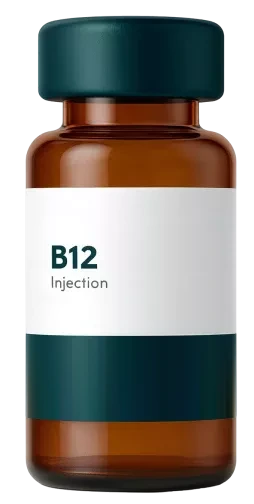
- Form
- Injection into muscle or under the skin
- Price
- From $125/month
- Prescription
- Required, after clinician review
- FDA status
- Cyanocobalamin injection is FDA-approved; methylcobalamin injections are compounded and not FDA-approved
How B12 Injection works
Vitamin B12 is needed to make red blood cells, maintain nerves and produce DNA. Absorbing it from food requires stomach acid and a protein called intrinsic factor. Injections skip the gut entirely and deliver B12 straight into tissue, which is why they work even when absorption is impaired.
Who it’s for, and who it isn’t
May be a fit
- Adults with low or borderline B12 levels, confirmed by blood tests
- People with conditions that block absorption, such as pernicious anemia, atrophic gastritis, celiac or Crohn's disease
- People who have had weight-loss surgery or part of the stomach or intestine removed
- Long-term users of metformin, proton pump inhibitors or H2 blockers with low levels
- Vegans and some vegetarians who are deficient despite oral supplements
Usually not a fit
- Anyone allergic to cobalt or to cyanocobalamin or hydroxocobalamin
- People with Leber's hereditary optic neuropathy, who should avoid cyanocobalamin
- People with unexplained anemia or nerve symptoms who have not yet been evaluated
- People with normal B12 who expect a guaranteed energy boost
What’s included
- Clinician review of symptoms, diet, medications and labs
- Guidance on B12 and related testing (labs priced separately)
- Injection supplies from a licensed U.S. pharmacy
- Training on self-injection
- Follow-up to recheck levels and adjust frequency
Possible side effects
- Soreness, redness or itching at the injection site
- Mild diarrhea
- A feeling of body swelling
- Rare: allergic reactions with rash, hives or trouble breathing
This isn’t a complete list. Your clinician reviews risks, interactions and warnings with you before prescribing. In an emergency, call 911.
What the evidence says
Injections are the standard treatment for B12 deficiency caused by poor absorption. A Cochrane review summarized by the NIH Office of Dietary Supplements found that very high oral doses (1,000 to 2,000 mcg) normalized B12 levels about as well as injections in small trials, so tablets are an option for some people. Evidence that B12 shots improve energy in people with normal levels is weak.
Who is most likely to be low
B12 deficiency becomes more common with age. Older adults often make less stomach acid, which is needed to release B12 from food. Pernicious anemia, an autoimmune condition, blocks intrinsic factor and makes absorption from food or standard supplements unreliable. Bowel conditions and gastric or bariatric surgery can have the same effect.
Medicines matter too. Long-term metformin, proton pump inhibitors and H2 blockers can all lower B12 absorption. People who eat few or no animal foods are also at higher risk because B12 is found naturally almost only in animal products.
Symptoms worth testing for
Low B12 can be subtle at first. It can cause tiredness, weakness, pale skin, a sore tongue, memory or mood changes and tingling or numbness in the hands and feet. Left untreated, nerve damage can become permanent, which is why testing matters if you have these symptoms or risk factors.
- Serum B12, with methylmalonic acid if results are borderline
- Complete blood count to look for anemia
- Folate, iron and thyroid tests, which can cause overlapping symptoms
Cyanocobalamin or methylcobalamin
Cyanocobalamin is the form used in FDA-approved B12 injections and most supplements. The body converts it into the active forms it uses. Methylcobalamin is one of those active forms and is popular in wellness settings; injectable methylcobalamin is available only through compounding pharmacies and is not FDA-approved, not reviewed by FDA for safety, effectiveness or quality, and not interchangeable with approved products.
The NIH Office of Dietary Supplements notes there is no evidence that absorption differs meaningfully by form. Your clinician will tell you which form is prescribed and why. Cyanocobalamin should be avoided in people with Leber's hereditary optic neuropathy.
Why B12 deserves attention in midlife
Several common midlife situations stack up B12 risk at once. Acid-reducing medicines for reflux are widely used for years at a time. Metformin is often started for prediabetes. Diets shift toward fewer animal foods for heart health or ethical reasons. Weight-loss surgery removes or bypasses the parts of the gut that absorb B12.
The symptoms of low B12, such as fatigue, brain fog, low mood and tingling feet, also overlap with perimenopause, low testosterone, thyroid problems and poor sleep. That overlap makes it easy to miss a deficiency, or to assume B12 is the answer when something else is going on. A simple blood test, sometimes with methylmalonic acid, separates the two and is worth doing before committing to months of injections.
Injections versus tablets
If your gut absorbs B12 normally, high-dose oral tablets can work well and cost less. Injections make most sense when absorption is clearly impaired, when levels are very low and need to rise quickly, when nerve symptoms are present or when you have not responded to tablets. Some people move from injections to tablets once their levels are stable.
Safety
B12 has very low toxicity, and no upper intake limit has been set, because the body does not store excess amounts in a harmful way. Injection-site soreness is the most common complaint. Rarely, people have allergic reactions, so tell your clinician about any cobalt allergy.
What your clinician monitors
Treatment often starts with more frequent injections to rebuild stores, followed by a maintenance schedule. Your clinician rechecks B12 and blood counts to confirm a response, and asks about energy, mood and nerve symptoms. If you have a lifelong cause such as pernicious anemia, treatment is usually ongoing, because the underlying absorption problem does not go away. If the cause is a medication or diet, your clinician may also discuss whether that can change, which sometimes allows a switch to tablets or a lower maintenance frequency over time.
If your levels were normal to begin with and you notice no benefit after a fair trial, stopping is reasonable. B12 injections cost from $125 a month with no membership fee; labs are billed separately, and your price is confirmed at the eligibility review.
Go deeper on B12 Injection
 Longevity & NAD+B12 injection candidacy · 5 min readWho actually needs B12 shots, and who can take a tabletPernicious anemia, gastric surgery, metformin, acid reducers, age and a vegan diet all affect B12. Learn which groups truly benefit from injections.Read more
 Longevity & NAD+B12 forms explained · 4 min readCyanocobalamin, methylcobalamin or hydroxocobalamin: does the form of B12 matter?Is methylcobalamin really better than cyanocobalamin? What the evidence says about B12 forms, the MTHFR claim, cyanide worries and hydroxocobalamin.Read more
 Longevity & NAD+B12 and your nerves · 4 min readTingling, numbness and balance problems: could it be B12?Tingling feet, numb hands or poor balance can signal low B12. Learn how deficiency harms nerves, what to test, and when to see a neurologist instead.Read more
Prescription treatments are available only to eligible patients after a clinical evaluation by an independently licensed clinician.
B12 Injection: common questions
Will B12 shots give me more energy?
If you are deficient, often yes, as levels recover. If your levels are normal, evidence for an energy boost is weak.
How quickly does a B12 shot work?
People who are deficient may feel better within days to weeks. Blood counts and nerve symptoms take longer to recover.
Are B12 tablets as good as injections?
For many people with normal absorption, high-dose tablets work about as well. Injections are preferred when absorption is impaired.
Is methylcobalamin better than cyanocobalamin?
There is no good evidence that either form is absorbed or used better. Injectable methylcobalamin is compounded and not FDA-approved.
Can I give the injections myself?
Yes. You will be shown how to inject into a muscle or under the skin before your first dose.
Does metformin lower B12?
Long-term metformin can reduce B12 absorption, so periodic testing is recommended.
Can I take too much B12?
B12 has very low toxicity and no set upper limit, but there is no benefit to taking more than you need.
Sources
We cite government agencies, professional societies and peer-reviewed research. See our editorial policy.
- Vitamin B12: Fact Sheet for Health ProfessionalsNIH Office of Dietary Supplements
- Cyanocobalamin InjectionMedlinePlus (National Library of Medicine)
- Bulk Drug Substances Nominated for Use in Compounding Under Section 503AU.S. Food and Drug Administration
- Compounding and the FDA: Questions and AnswersU.S. Food and Drug Administration