

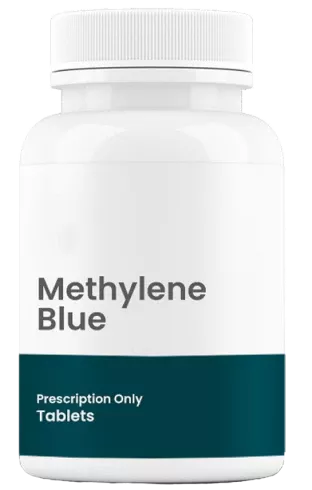
- Form
- Low-dose oral capsule
- Price
- From $149/month; 3 months $299 ($100/month)
- Prescription
- Required, after clinician review
- FDA status
- Compounded; not FDA-approved for energy or cognition
Methylene Blue is a compounded medication. Compounded medications are not FDA-approved, and the FDA has not reviewed them for safety, effectiveness or quality. What compounded means
How Methylene Blue works
Methylene blue can accept and donate electrons, which lets it act as an alternative electron carrier in the mitochondrial energy chain. In lab and animal studies, low doses support mitochondrial respiration and reduce some kinds of oxidative stress. It also inhibits monoamine oxidase A, the enzyme that breaks down serotonin, which explains its dangerous interaction with serotonergic drugs.
Who it’s for, and who it isn’t
May be a fit
- Adults curious about mitochondrial support who accept that evidence is preliminary
- People not taking serotonergic medicines such as SSRIs, SNRIs, MAOIs, some opioids or triptans
- People willing to be screened for G6PD deficiency before starting
Usually not a fit
- Anyone taking antidepressants or other serotonergic drugs, because of the risk of serotonin syndrome
- People with G6PD deficiency, who can develop serious red blood cell breakdown
- People who are pregnant, trying to conceive or breastfeeding
- Anyone with a known allergy to methylene blue or other thiazine dyes
- People with significant kidney impairment without specialist review
What’s included
- Clinician medication review focused on serotonergic drugs
- G6PD screening guidance (labs priced separately)
- Pharmaceutical-grade compounded capsules from a licensed U.S. pharmacy
- Follow-up on tolerance and any change in energy or focus
Possible side effects
- Blue or green urine, and sometimes blue-tinged stool or tongue
- Nausea or stomach upset
- Headache or dizziness
- Confusion or vision changes at higher exposures
- Falsely low readings on pulse oximeters
- Rare but serious: serotonin syndrome with interacting drugs, hemolysis in G6PD deficiency
This isn’t a complete list. Your clinician reviews risks, interactions and warnings with you before prescribing. In an emergency, call 911.
What the evidence says
Methylene blue is FDA-approved, as an intravenous product, to treat acquired methemoglobinemia, a blood disorder. Interest in low-dose use for energy, memory and aging comes mostly from cell and animal studies and a small number of short human studies. There are no long-term trials showing benefits for healthy adults, and any such use is off-label.
From hospital drug to wellness trend
Methylene blue has been used in medicine for more than a century. Today its approved role is narrow: an intravenous form treats methemoglobinemia, a condition in which blood cannot carry oxygen properly. Surgeons also use it as a dye.
Its newer popularity comes from research on mitochondria, the parts of cells that produce energy. Because methylene blue can shuttle electrons, researchers have explored whether small doses might help mitochondria work more efficiently, particularly in the brain. These are intriguing ideas, but they have not yet been confirmed by robust human trials.
The serotonin warning comes first
The FDA-approved product carries a boxed warning: serious or fatal serotonin syndrome can occur when methylene blue is combined with serotonergic drugs. FDA's reported cases involved SSRIs, SNRIs and clomipramine, and the risk with other psychiatric drugs, including MAOIs, bupropion, mirtazapine and trazodone, is unclear. The label also warns against combining it with opioids.
FDA has said it is not known whether low oral doses carry the same risk as the intravenous doses in those reports. Your clinician treats the interaction as real regardless. If you take any antidepressant, migraine triptan, certain pain medicines or other serotonergic drugs, methylene blue is very likely not an option.
- Agitation, confusion, fast heartbeat, fever, sweating, muscle twitching or stiffness: seek emergency care
- Never start a new prescription without telling the prescriber you take methylene blue
G6PD screening
People with G6PD deficiency, an inherited enzyme condition more common in people of African, Mediterranean, Middle Eastern and South Asian ancestry, can have their red blood cells break down when exposed to methylene blue. The approved product lists G6PD deficiency as a contraindication. Your clinician will ask about your history and may recommend a G6PD blood test before prescribing.
Why grade and source matter
Methylene blue is sold online in industrial, laboratory and aquarium grades that are not intended for people and may contain impurities such as heavy metals. A prescription product is compounded by a licensed U.S. pharmacy from pharmaceutical-grade material. Even so, compounded methylene blue is not FDA-approved, FDA has not reviewed it for safety, effectiveness or quality, and it is not interchangeable with the approved intravenous product.
How it compares with NAD+ and glutathione
Methylene blue, NAD+ and glutathione are often grouped together as cellular-energy or longevity treatments, but they work differently. NAD+ is a coenzyme the mitochondria already use; injections try to top up the supply. Glutathione is the body's main internal antioxidant. Methylene blue is a foreign compound that can step into the energy chain itself and also blocks an enzyme that breaks down serotonin.
That last point is why methylene blue has the most demanding screening of the three. None of them has strong evidence for improving energy or slowing aging in healthy adults, so the choice often comes down to your medication list, your tolerance for uncertainty and what your clinician thinks is worth a defined trial. Sleep, strength training and treating any underlying condition still come first.
What to expect day to day
Almost everyone notices blue or green urine, which is harmless but can be startling. It can also interfere with some urine dipstick tests and make pulse oximeters read falsely low, so tell any care team you take it. Some people report sharper focus or more energy; others notice nothing. Nausea and headache are possible.
What your clinician monitors
Before you start, your clinician reviews every medication and supplement you take, including over-the-counter products such as dextromethorphan and St. John's wort. Follow-up covers side effects, any new prescriptions and whether you are noticing a meaningful benefit. If not, stopping after a defined trial is reasonable.
Methylene blue costs from $149 a month, or $299 for 3 months ($100 a month), with no membership fee. Labs, including any G6PD test, are billed separately, and your price is confirmed at the eligibility review.
Go deeper on Methylene Blue
 Getting startedMethylene blue · 5 min readMethylene blue and antidepressants: why this combination is off the tableMethylene blue blocks MAO-A and can trigger serotonin syndrome with SSRIs, SNRIs and other serotonergic drugs. See which medicines conflict and why we screen.Read more
 Getting startedMethylene blue · 5 min readMethylene blue and cognition: what the human evidence really showsMethylene blue is marketed as a nootropic, but human evidence is thin: one small single-dose imaging study and failed Alzheimer's trials. See the full picture.Read more
 Getting startedMethylene blue · 4 min readMethylene blue and G6PD deficiency: the test that comes firstMethylene blue can cause severe red blood cell breakdown in people with G6PD deficiency. Learn who is at risk, how testing works and the warning signs to watch.Read more
Prescription treatments are available only to eligible patients after a clinical evaluation by an independently licensed clinician.
Methylene Blue: common questions
Is methylene blue FDA-approved for energy or brain health?
No. It is FDA-approved only as an intravenous treatment for methemoglobinemia. Other uses are off-label and supported by early evidence.
Can I take it with an antidepressant?
Usually not. Combining methylene blue with SSRIs, SNRIs and other serotonergic drugs can cause serotonin syndrome, which can be fatal.
Why does my urine turn blue or green?
Methylene blue is a dye that leaves the body in urine. The color change is expected and harmless.
What is wrong with aquarium methylene blue?
Non-pharmaceutical grades are not made for human use and may contain contaminants. Only pharmaceutical-grade material is appropriate.
Do I need a G6PD test?
Your clinician may recommend one, especially if your ancestry or family history suggests risk. G6PD deficiency is a reason not to take methylene blue.
How soon might I notice a change?
People who notice effects usually describe them within days to a few weeks. Many notice no difference.
Is it safe in pregnancy?
No. The approved product may cause fetal harm, and methylene blue should not be used during pregnancy or breastfeeding.
Sources
We cite government agencies, professional societies and peer-reviewed research. See our editorial policy.
- PROVAYBLUE (methylene blue) injection prescribing informationU.S. Food and Drug Administration
- FDA Drug Safety Communication: Updated information about the drug interaction between methylene blue and serotonergic psychiatric medicationsU.S. Food and Drug Administration
- Compounding and the FDA: Questions and AnswersU.S. Food and Drug Administration